
Harnessing Forex Correlation Dynamics: A Game-Changing Strategy for Trading Success
Categories: Forex Trading
Tags: forex correlation
Publish date: 2024-9-7
In the ever-evolving landscape of Forex trading, staying ahead of the curve is not just a competitive advantage; it's a necessity for survival. One of the most potent tools traders can wield to gain this edge is harnessing Forex correlation dynamics. Understanding the intricate relationships between different currency pairs can unlock a world of opportunities, allowing traders to make more informed decisions, capitalise on market movements, and manage risk more effectively.
In this comprehensive guide, we will delve deep into the world of Forex correlation dynamics, exploring its concepts, applications, and benefits. We will incorporate the formula of "Pearson Correlation" to demonstrate its significance in quantifying these relationships and discuss how FXCM, can support traders in their quest for success.
Table of Contents
What are Forex Correlation Dynamics?
Why Pearson Correlation Matters
Calculating Pearson Correlation
Interpreting Correlation Coefficients
How to Identify and Analyze Forex Correlations
Applying Forex Correlation Dynamics in Trading Strategies
Risk Management
Enhanced Trading Strategies
Identifying Market Opportunities
Practical Tips for Harnessing Correlation Dynamics
Monitor Correlation Changes
Diversify Your Portfolio
Use Correlations for Confirmation
Hedge Your Positions
Case Study: Applying Forex Correlation Dynamics in Real-World Trading
FXCM: A Leading Provider of Online Foreign Exchange (FX) Trading
Conclusion
FAQs

What are Forex Correlation Dynamics?
Forex correlation dynamics refer to the relationship between the price movements of different currency pairs. These relationships can be positive, negative, or non-existent, and they can vary in strength over time. Understanding these dynamics is crucial for traders as it provides valuable insights into market behaviour and potential trading opportunities.
Positive correlation means that two currency pairs tend to move in the same direction. For example, if the EUR/USD and GBP/USD are positively correlated, an increase in the value of the EUR/USD is likely to be accompanied by an increase in the value of the GBP/USD.
Negative correlation, on the other hand, indicates that two currency pairs move in opposite directions. For instance, if the USD/JPY and the EUR/USD are negatively correlated, a rise in the value of the EUR/USD would likely be accompanied by a fall in the value of the USD/JPY.
Why Pearson Correlation Matters
When it comes to quantifying the strength and direction of these relationships, the Pearson correlation coefficient is a widely used statistical measure. The Pearson correlation coefficient ranges from -1 to 1, with a value of 1 indicating a perfect positive correlation, -1 indicating a perfect negative correlation, and 0 indicating no correlation.
By calculating the Pearson correlation coefficient between currency pairs, traders can gain a more precise understanding of how they move together. This information can then be used to inform trading decisions, such as identifying potential trading opportunities or hedging positions to reduce risk.
Calculating Pearson Correlation
The Pearson correlation coefficient (r) ranges from -1 to 1:
- 1: Perfect positive correlation
- -1: Perfect negative correlation
- 0: No correlation
The formula for calculating the Pearson correlation coefficient is:
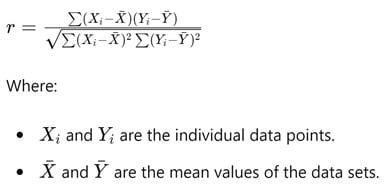
Interpreting Correlation Coefficients
- 8 to 1.0 (or -0.8 to -1.0): Very strong correlation
- 6 to 0.8 (or -0.6 to -0.8): Strong correlation
- 4 to 0.6 (or -0.4 to -0.6): Moderate correlation
- 2 to 0.4 (or -0.2 to -0.4): Weak correlation
- 0 to 0.2 (or -0.0 to -0.2): Very weak or no correlation

How to Identify and Analyze Forex Correlations
Identifying and analysing Forex correlations is a crucial step in harnessing their power. Here are some steps traders can follow to get started:
- Use Correlation Matrices and Heat Maps
Correlation matrices and heat maps are powerful tools that provide a visual representation of the correlation between different currency pairs. These tools display the Pearson correlation coefficient between pairs, making it easy for traders to identify positive, negative, or non-existent correlations. - Analyze Historical Data
Looking at historical data can provide valuable insights into how currency pairs have moved together in the past. Traders can use technical analysis tools, such as charts and indicators, to identify candlestick patterns and trends in the correlation between pairs. This information can then be used to forecast future movements and inform trading decisions. - Stay Up-to-Date with Market News and Events
Correlation dynamics can change rapidly in response to market news and events. Staying informed about economic data releases, central bank policy decisions, and geopolitical developments can help traders anticipate changes in correlation and adjust their strategies accordingly.
Applying Forex Correlation Dynamics in Trading Strategies
Once traders have identified and analysed Forex correlations, they can use this information to develop and refine their trading strategies. Here are some ways in which correlation dynamics can be applied:
Risk Management
One of the primary benefits of understanding correlation dynamics is improved risk management. By identifying positively or negatively correlated pairs, traders can diversify their portfolios to reduce exposure to risk. For example, if you hold positions in two positively correlated pairs, any adverse movement in one pair will likely affect the other. By balancing your positions with negatively correlated pairs, you can mitigate potential losses.
Enhanced Trading Strategies
Incorporating correlation dynamics into your trading strategies can significantly enhance their effectiveness. For instance, if you notice a strong positive correlation between EUR/USD and GBP/USD, you can use this information to confirm trade signals. If both pairs show bullish signals, it increases the likelihood of a successful trade. Similarly, negative correlations can be used to hedge positions and protect against unfavourable market movements.
Identifying Market Opportunities
Correlation analysis can also help in identifying new market opportunities. By understanding how different pairs interact, traders can spot trends and patterns that may not be evident when analysing forex pairs in isolation. This broader perspective can lead to the discovery of profitable trading opportunities that might otherwise be overlooked.
Practical Tips for Harnessing Correlation Dynamics
Monitor Correlation Changes
Correlations between currency pairs are not static; they can change over time due to various market factors such as economic events, geopolitical developments, and changes in market sentiment. It is essential to regularly monitor these changes to stay ahead of the market and adjust your strategies accordingly.
Diversify Your Portfolio
Portfolio diversification is a key principle in risk management. By spreading your investments across pairs with different correlation dynamics, you can reduce the impact of adverse movements in any single pair. This approach helps in creating a more balanced and resilient portfolio.
Use Correlations for Confirmation
When entering a trade, use correlation analysis to confirm your signals. If you are considering a long position in EUR/USD, check the correlation with other pairs such as GBP/USD or USD/JPY. If these pairs also show bullish signals, it adds weight to your decision and increases the likelihood of a successful trade.
Hedge Your Positions
Hedging is an effective way to protect against potential losses. By taking positions in negatively correlated pairs, you can offset losses in one pair with gains in another. For example, if you have a long position in EUR/USD and are concerned about potential downside risk, you can take a short position in a negatively correlated pair to hedge your exposure.

Case Study: Applying Forex Correlation Dynamics in Real-World Trading
To illustrate the practical application of correlation dynamics in Forex trading, let's consider a case study.
Suppose a trader is analysing the EUR/USD and USD/JPY currency pairs. Using a correlation matrix, they discover that these two pairs are negatively correlated, with a Pearson correlation coefficient of -0.7. This indicates a strong negative relationship between the two pairs.
Based on this information, the trader decides to open a long position in the EUR/USD, anticipating that it will rise in value. However, to mitigate risk, they also open a short position in the USD/JPY, which is negatively correlated with the EUR/USD.
As the market moves, the EUR/USD indeed rises as expected, while the USD/JPY falls. This negative correlation between the two pairs works in the trader's favour, as their long position in the EUR/USD profits while their short position in the USD/JPY also generates gains. As a result, the trader is able to capture profits from both trades, while also reducing their overall risk by hedging their positions.
FXCM: An Online Foreign Exchange (FX) Trading Provider
When it comes to implementing advanced trading strategies such as correlation dynamics, choosing the right trading platform is crucial. FXCM offers a comprehensive suite of tools and resources to help traders make informed decisions. With its user-friendly interface, advanced charting capabilities, and real-time market data, FXCM provides an ideal environment for traders to analyse correlations and execute their strategies effectively.
Features of FXCM
- Advanced Charting Tools: FXCM offers a wide range of charting tools that allow traders to visualise correlations and identify trading opportunities.
- Real-Time Market Data: Access to real-time market data ensures that traders have the most up-to-date information for making informed decisions.
- Educational Resources: FXCM provides extensive educational resources, including webinars, tutorials, and articles, to help traders understand and apply correlation dynamics in their trading strategies.
- User-Friendly Interface: The intuitive interface of FXCM makes it easy for traders of all levels to navigate the platform and execute their trades efficiently. Start by practising on paper or with a demo trading account. This allows you to apply your knowledge of forex correlations in a risk-free environment.
Conclusion
Harnessing Forex correlation dynamics is a game-changing strategy for trading success. By understanding the relationships between different currency pairs, traders can make more informed decisions, identify potential trading opportunities, and better manage their risk. With the help of advanced trading tools and resources by FXCM, traders can harness the power of correlation dynamics effectively and achieve their trading goals.
In conclusion, traders who take the time to learn about and apply Forex correlation dynamics in their trading strategies stand to gain a significant competitive advantage in the market. By staying informed about market news and events, analysing historical data, and using advanced trading tools, traders can unlock the full potential of correlation dynamics and achieve consistent trading success.
FAQs
Q1: What exactly is correlation dynamics in Forex trading?
A: Correlation dynamics refers to the relationship between different currency pairs in the Forex market. This relationship can be positive (moving in the same direction) or negative (moving in opposite directions). Understanding this relationship helps traders make more informed decisions and increase their chances of success.
Q2: How can I identify correlated currency pairs in Forex trading?
A: To identify correlated currency pairs, traders can use various tools and resources such as correlation matrices, Forex heat maps, and currency pair analyzers. These tools provide a visual representation of the relationship between different currency pairs, making it easier to identify positive or negative correlations.
Q3: What are the benefits of harnessing correlation dynamics in Forex trading?
A: Harnessing correlation dynamics can provide several benefits, including improved decision-making, increased trading opportunities, and better risk management. By understanding the relationship between currency pairs, traders can make more informed trades, spot potential opportunities that may have been missed, and reduce their overall risk by hedging their positions.
Q4: How can I analyse the relationship between correlated currency pairs?
A: To analyse the relationship between correlated currency pairs, traders should look at historical data to determine whether the relationship is positive or negative and whether it is strong or weak. They can use technical analysis tools such as charts/candlestick patterns and indicators to visualise the relationship and identify patterns or trends.
Q5: Can FXCM help me harness correlation dynamics in Forex trading?
A: Yes, FXCM offers traders access to a wide range of currency pairs and trading tools. FXCM's trading platform is user-friendly and provides real-time market data, advanced charting tools, and technical analysis indicators, making it easier for traders to harness correlation dynamics and take advantage of potential trading opportunities in the Forex market.
[Disclaimer] The articles above are purely personal opinions and are not intended to be investment advice. Only for the purpose of mutual learning and sharing. There is no express or implied warranty regarding the accuracy or completeness of the above-mentioned information. Anyone who relies on the information, ideas, or data contained in this article does so entirely at their own risk.